


AUSTIN, TEXAS – In a move that signals a massive shift in the global semiconductor landscape, Elon Musk has announced his most ambitious infrastructure project to date: Terafab. This sprawling facility, to be built in the heart of Texas, aims to produce the “digital brains” required to power the next century of human—and robotic—evolution.
”We are moving past the era of buying general-purpose chips,” Musk stated during the announcement. “To reach Level 5 autonomy, functional humanoid robotics, and a multi-planetary data network, we need silicon that doesn’t exist yet. Terafab is where we build it.”
Key Project Details: “Terafab”
• Location: Austin, Texas (integrated into the “Starbase-to-Giga” corridor).
• The Partnership: A first-of-its-kind joint venture between Tesla and SpaceX, with infrastructure support for xAI.
• The Mission: To achieve “Compute Sovereignty.” Musk wants to bypass traditional chipmakers (like NVIDIA or TSMC) to build highly specialized silicon that can survive both the heat of a robot’s chest cavity and the radiation of deep space.
• Technical Goal: Targeting 1 Terawatt (TW) of compute power capacity. This involves high-density liquid cooling systems and 2nm architecture.
Vertical Integration: The facility will handle everything from raw wafer processing to final system-on-chip (SoC)
A Duel-Purpose Powerhouse
The project is a rare formal collaboration between Tesla and SpaceX. While Tesla requires massive quantities of low-latency chips for its Optimus robot and Full Self-Driving (FSD) suites, SpaceX is looking toward the stars.
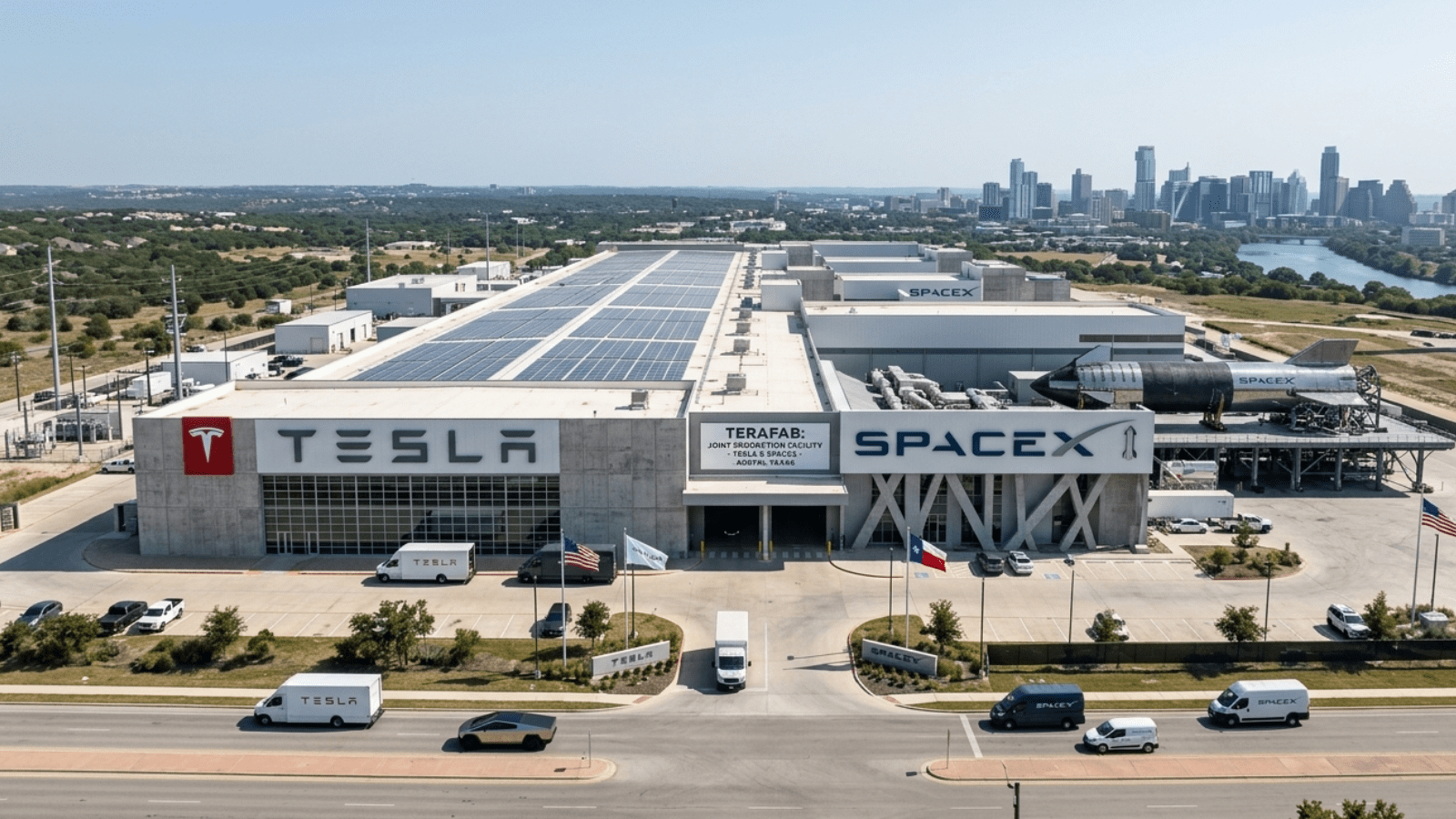
The facility is expected to produce the “D3” Space-Grade Processor, a chip specifically hardened against cosmic radiation. These chips are intended to power orbital data centers, allowing for high-speed AI processing in space without the need to send data back to Earth’s surface for every calculation.
Economic and Strategic Impact
With an estimated investment of $25 billion, Terafab is poised to turn Austin into the “Silicon Prairie.” By bringing chip manufacturing in-house, Musk is effectively insulating his companies from global supply chain shocks and the geopolitical tensions surrounding semiconductor hubs in Asia.
Industry analysts suggest that if Terafab hits its production targets, it could make Tesla one of the largest chip designers in the world, rivaling the output of dedicated tech giants.
The “Optimus” Factor
Perhaps the most “Sci-Fi” aspect of the plan is the labor force. Musk hinted that the Terafab production lines will be the primary testing ground for the Optimus humanoid robot. “It’s a closed loop,” Musk explained. “The robots will help build the chips that eventually make the robots smarter.”
The Bottom Line
Terafab represents Musk’s ultimate bet on vertical integration. By controlling the silicon, he controls the intelligence of his machines. If successful, the chips born in Austin will not only drive our cars but may eventually navigate the first crewed missions to Mars.